October 9, 2026
The Ratio That Predicts Cognitive Decline: Why Total Omega-3 Intake Isn’t Enough
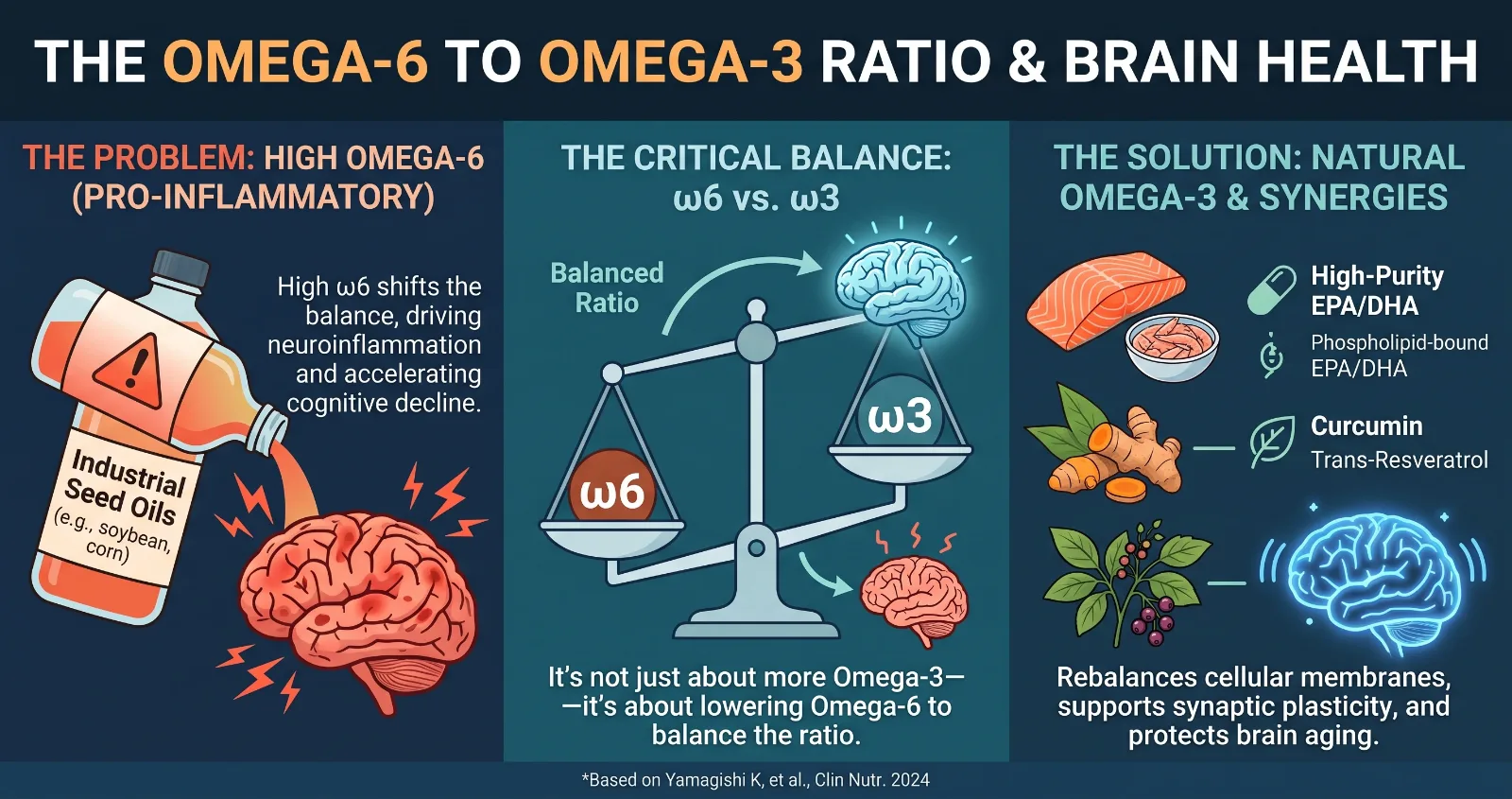
Many high performers add a standard fish oil capsule to their morning stack and consider their brain health optimized. However, clinical research highlights a critical nuance: the absolute quantity of circulating Omega-3 ($\omega3$) fatty acids is far less predictive of cognitive outcomes than the relative balance between Omega-6 ($\omega6$) and Omega-3 intake.
A skewed $\omega6/\omega3$ ratio functions as a reliable biomarker for accelerated cognitive decline and progression toward dementia. Mitigating neurodegenerative trajectories requires moving beyond isolated megadoses to structurally re-engineer the cellular lipid environment.
The Science Unpacked: Shifting Pro-Inflammatory Lipid Mediators
Cellular membranes—particularly within the brain—are dynamic structures composed of polyunsaturated fatty acids that compete directly for metabolic incorporation and enzymatic processing:
-
Pro-Inflammatory Lipid Signaling: Diets dominated by excess $\omega6$ polyunsaturated fatty acids flood cellular membranes with substrate precursors that drive arachidonic acid cascades, fueling continuous pro-inflammatory lipid mediators.
-
Neuronal Membrane Fluidity & Integrity: Long-chain $\omega3$ fatty acids (EPA and DHA) integrate directly into the phospholipid bilayer, stabilizing receptor conformations, supporting synaptic plasticity, and yielding anti-inflammatory eicosanoids.
-
Neuroinflammatory Load as a Prognostic Marker: When the $\omega6/\omega3$ ratio tilts excessively high, baseline microglial activation and systemic inflammatory tone rise, accelerating synaptic decay, working memory deficits, and structural degradation in executive processing centers.
Practical Implications & Pharmacokinetic Considerations
-
The Ratio Bottleneck: Attempting to compensate for a diet rich in industrial seed oils (corn, soybean, cottonseed) solely through isolated fish oil supplements is biochemically inefficient. Achieving neuroprotection requires concurrently lowering dietary $\omega6$ exposure while introducing concentrated, high-purity $\omega3$ sources to rebalance the systemic ratio.
-
Bioavailability & Bilayer Transport: As lipophilic molecules, both fatty acid families require dietary fats for optimal micellar absorption and incorporation into chylomicrons. Delivering $\omega3$ fatty acids in triglyceride or phospholipid-bound configurations accelerates incorporation across mucosal barriers and through the blood-brain barrier into neural membranes.
-
Safety & Quality Control: Rebalancing the fatty acid profile carries a high safety index. However, oxidized or low-grade fish oils containing toxic lipid peroxides can paradoxically elevate oxidative stress, making verified third-party testing for peroxide values and heavy metal filtration essential.
Strategic Stacking & Lipid Synergies
To actively shift the inflammatory index and protect vulnerable neuronal architecture, optimize lipid protocols using complementary synergies:
-
Phospholipid-Bound EPA/DHA: Prioritizes phospholipid or re-esterified triglyceride formats over ethyl esters to accelerate direct incorporation into neuronal membranes.
-
Curcumin (Phytosome Form): Provides secondary non-overlapping suppression of downstream NF-$\kappa$B transcriptional activity, neutralizing lingering inflammatory cascades triggered by elevated baseline $\omega6$ stores.
-
Standardized Trans-Resveratrol: Stimulates SIRT1 pathways and supports microvascular endothelial integrity, complementing $\omega3$ membrane stabilization with enhanced cerebral perfusion and metabolic resilience.
-
Mixed Tocopherols (Vitamin E): Protects circulating and membrane-bound polyunsaturated fatty acids from in vivo lipid peroxidation, preserving structural longevity.
Academic Reference
Yamagishi K, et al., Prediction of cognitive outcome and progression to dementia using $\omega6$ PUFA/$\omega3$ PUFA ratio: A prospective cohort study. Clin Nutr. 2024 May 08. doi: 10.1016/j.clnu.2024.05.012. Epub ahead of print. PMID: 42271192 (https://pubmed.ncbi.nlm.nih.gov/42271192/)
Immediate Implementation Checklist
-
Conduct a Dietary Lipid Audit: Eliminate hidden sources of refined industrial seed oils (soybean, corn, cottonseed, and generic vegetable oil) from daily meals to lower competing $\omega6$ substrate levels.
-
Transition to Concentrated Phospholipid Formats: Administer 1,500–2,000 mg of combined EPA/DHA daily in triglyceride or phospholipid form, scheduled alongside a meal containing healthy fats for maximal bilayer integration.
-
Establish Baseline Testing: Schedule an RBC fatty acid profile (Omega-3 Index with complete $\omega6/\omega3$ ratio breakdown) to benchmark systemic tissue ratios and assess rebalancing progress over 90- to 120-day red blood cell turnover windows.