October 2, 2026
The Bioenergetic Buffer: How Mitochondrial Fitness Defends the Brain Against Structural Pathology
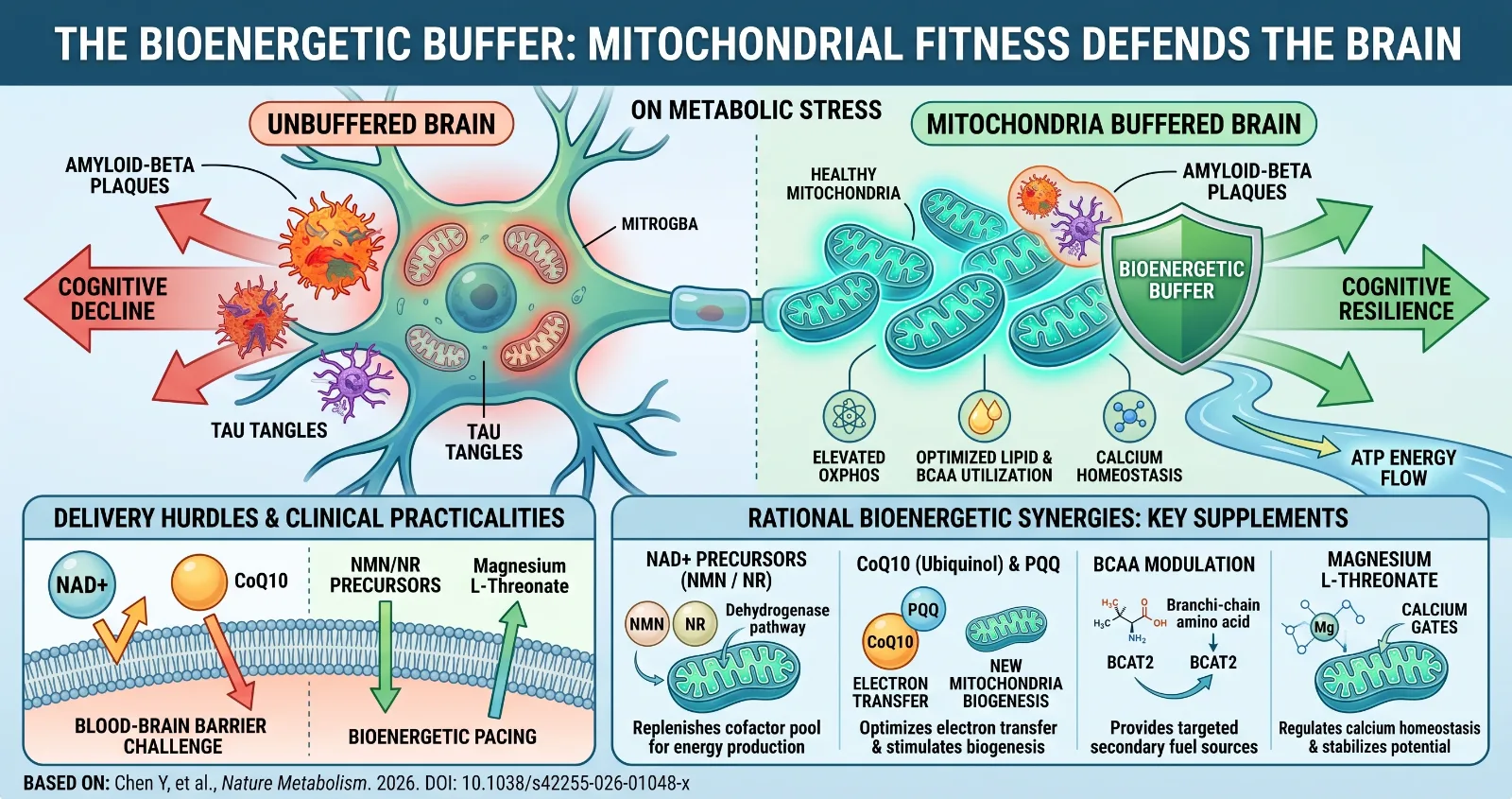
For decades, the standard playbook for neurodegenerative decline has zeroed in on physical brain lesions—specifically amyloid-beta plaques and hyperphosphorylated tau tangles. Yet a longstanding clinical paradox challenges this narrow focus: why do some individuals carry heavy neuropathological burdens while remaining completely asymptomatic and intellectually sharp?
Recent molecular profiling uncovers the dividing line: mitochondrial bioenergetic signatures. High-performing cellular powerhouses act as a biological buffer, decoupling structural brain pathology from symptomatic cognitive decline.
The Molecular Architecture: Energy Over Anatomy
The difference between clinical decline and cognitive resilience comes down to how effectively neurons generate adenosine triphosphate (ATP) and manage bioenergetic substrate flow under stress:
-
Elevated Oxidative Phosphorylation (OXPHOS): Resilient brains sustain higher electron transport chain efficiency, preserving mitochondrial membrane potential and maintaining steady energy production despite cellular insults.
-
Optimized Lipid & Amino Acid Utilization: Asymptomatic profiles demonstrate superior metabolic flexibility through enhanced lipid metabolism (via enzymes like CPT2) and branched-chain amino acid (BCAA) catabolism driven by BCAT2. This ensures neurons maintain secondary fuel sources when primary glucose handling falters.
-
Enzymatic Defense and Ribosomal Integrity: Upregulated markers such as MRPL47 (mitochondrial ribosomal protein) and IDH2 (isocitrate dehydrogenase) reinforce structural mitochondrial biogenesis and replenish NADPH to counter local oxidative cascades.
-
Calcium Homeostasis: Robust mitochondria act as dynamic calcium sinks, buffering intracellular calcium surges that would otherwise trigger excitotoxic cascades and apoptotic cell death.
Delivery Hurdles and Clinical Practicalities
Translating mitochondrial optimization into human regimens requires navigating clear biochemical barriers:
-
The NAD+ Delivery Challenge: Because full NAD+ molecules cannot directly cross the blood-brain barrier effectively, protocols rely on smaller precursors such as Nicotinamide Mononucleotide (NMN) or Nicotinamide Riboside (NR) to elevate central NAD+/NADH ratios and fuel OXPHOS pathways.
-
Bioenergetic Pacing: Interventions designed to upregulate mitochondrial respiration must match cellular antioxidant capacity. Ramping up electron flux without sufficient cofactors can elevate reactive oxygen species (ROS) or cause metabolic over-stimulation in compromised systems.
-
Safety Boundaries: Precursor supplementation is broadly well tolerated, but individual metabolic baselines should guide dosing schedules to ensure sustained steady-state efficiency without metabolic stress.
Rational Bioenergetic Synergies
Pairing targeted compounds creates complementary support across the entire mitochondrial respiration and regulatory architecture:
-
NAD+ Precursors (NMN / NR): Directly replenish the essential cofactor pool required for dehydrogenase activity (including IDH2) and electron transport chain complex I turnover.
-
CoQ10 (Ubiquinol) & PQQ: CoQ10 optimizes electron transfer through complexes I–III, while Pyrroloquinoline Quinone (PQQ) stimulates PGC-1$\alpha$ signaling to promote new mitochondrial biogenesis alongside MRPL47-driven protein synthesis.
-
Branched-Chain Amino Acid (BCAA) Modulation: Provides targeted metabolic fuel to engage the BCAT2 transamination pathway, bolstering secondary energy generation in neural tissue.
-
Magnesium L-Threonate: Highly bioavailable to the central nervous system, serving as an essential cofactor to regulate mitochondrial calcium gates and stabilize membrane potential.
Reference: Mandal, Purba, et al. "Mitochondrial bioenergetic signatures differentiate asymptomatic from symptomatic Alzheimer’s disease." Communications Biology (2026). PMID: 42270947 (https://pubmed.ncbi.nlm.nih.gov/42270947/)