October 3, 2026
Taming the Excitotoxic Storm: How DHA Shields Neurons Against Glutamate Overload
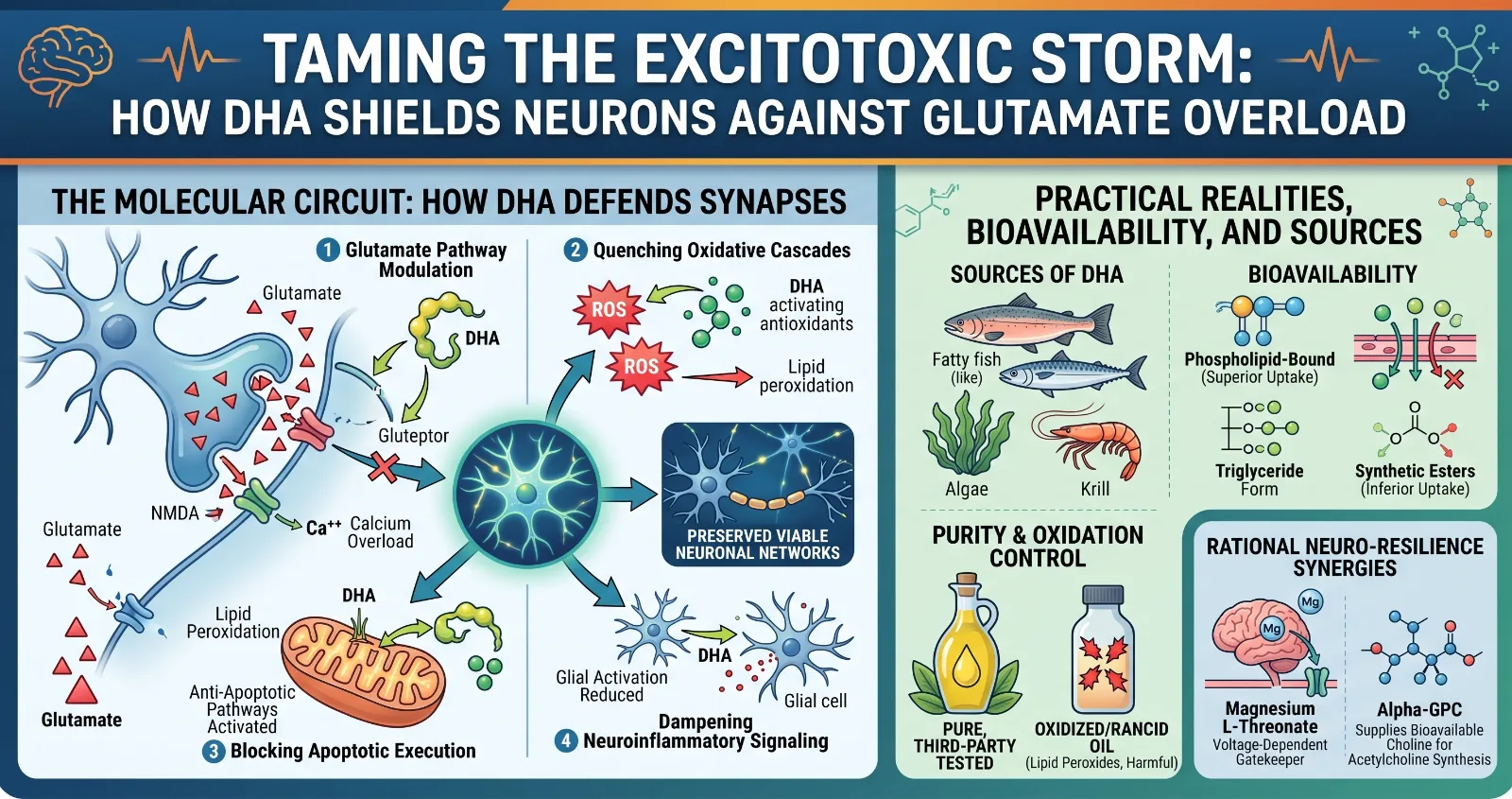
Glutamate is the brain’s principal excitatory neurotransmitter, driving learning, synaptic transmission, and rapid information processing. However, high-demand cognitive states and chronic metabolic strain can push glutamate signaling past its functional threshold, resulting in excitotoxicity—a destructive cascade where sustained receptor stimulation floods neurons with calcium, triggers oxidative collapse, and accelerates synaptic loss.
Recent research underscores the essential role of Docosahexaenoic Acid (DHA) in defusing this cascade. Far from being a passive structural lipid, DHA acts as an active biochemical shield that mitigates glutamate-mediated neurotoxicity, halts apoptotic signaling, and supports cognitive endurance.
The Molecular Circuit: How DHA Defends Synapses
When elevated extracellular glutamate threatens neuronal survival, DHA deploys a multi-tiered defense across cellular membranes:
-
Glutamate Pathway Modulation: DHA regulates glutamate-related receptor activity and downstream signaling, buffering the cell against toxic over-activation and subsequent intracellular calcium overload.
-
Quenching Oxidative Cascades: Excitotoxic conditions unleash destructive surges of reactive oxygen species (ROS). DHA engages endogenous antioxidant pathways to neutralize oxidative insults and stabilize vulnerable neuronal membranes against lipid degradation.
-
Blocking Apoptotic Execution: Unchecked excitotoxicity triggers mitochondrial permeability and programmed cell death. DHA activates anti-apoptotic survival pathways, keeping the cellular machinery intact and preserving viable neuronal networks for memory consolidation.
-
Dampening Neuroinflammatory Signaling: By downregulating secondary neuroinflammatory markers elicited by cellular distress, DHA prevents local glial cells from entering a chronic hyper-reactive state that degrades surrounding synapses.
Practical Realities, Bioavailability, and Safety
Translating DHA’s neuroprotective mechanisms into real-world outcomes requires understanding its structural dynamics and kinetics:
-
Dose and Duration Over Acute Fixes: Neuroprotection against excitotoxicity is cumulative rather than instantaneous. Efficacy depends on consistent, long-term administration to achieve steady-state incorporation into neural membrane phospholipids.
-
Bioavailability and Carrier Form: To cross the blood-brain barrier efficiently, the molecular form matters. Phospholipid-bound or high-purity triglyceride forms typically exhibit superior uptake and neural membrane deposition compared to low-grade synthetic esters.
-
Purity and Oxidation Control: While DHA is generally recognized as safe (GRAS), its multi-double-bond structure makes it highly prone to rancidity. Rancid, oxidized oils generate lipid peroxides that directly provoke the very inflammatory and oxidative damage DHA is intended to prevent. High-purity, third-party-tested formulations are essential.
Rational Neuro-Resilience Synergies
Pairing DHA with targeted compounds creates a comprehensive defense system that regulates neurotransmission while reinforcing structural integrity:
-
Magnesium L-Threonate: Highly efficient at crossing the blood-brain barrier, it acts as a physiological voltage-dependent gatekeeper on NMDA receptors, directly dampening excessive glutamate influx while DHA protects the membrane downstream.
-
Alpha-GPC: Supplies bioavailable choline to bolster acetylcholine synthesis, complementing DHA's structural neuroprotection with active cholinergic support for focus and working memory.
Reference: Gómez-Pinilla F, Tyagi E, et al., Potential Neuroprotective Effects of Docosahexaenoic Acid on Glutamate-Induced Neurotoxicity. Neurochemical Research. 2026 Jun 13. doi: 10.1007/s11064-026-04182-9. Epub ahead of print. PMID: 42280463 (https://pubmed.ncbi.nlm.nih.gov/42280463/)