September 17, 2026
Taming Neuroinflammation: The Pharmacodynamics of Albiflorin
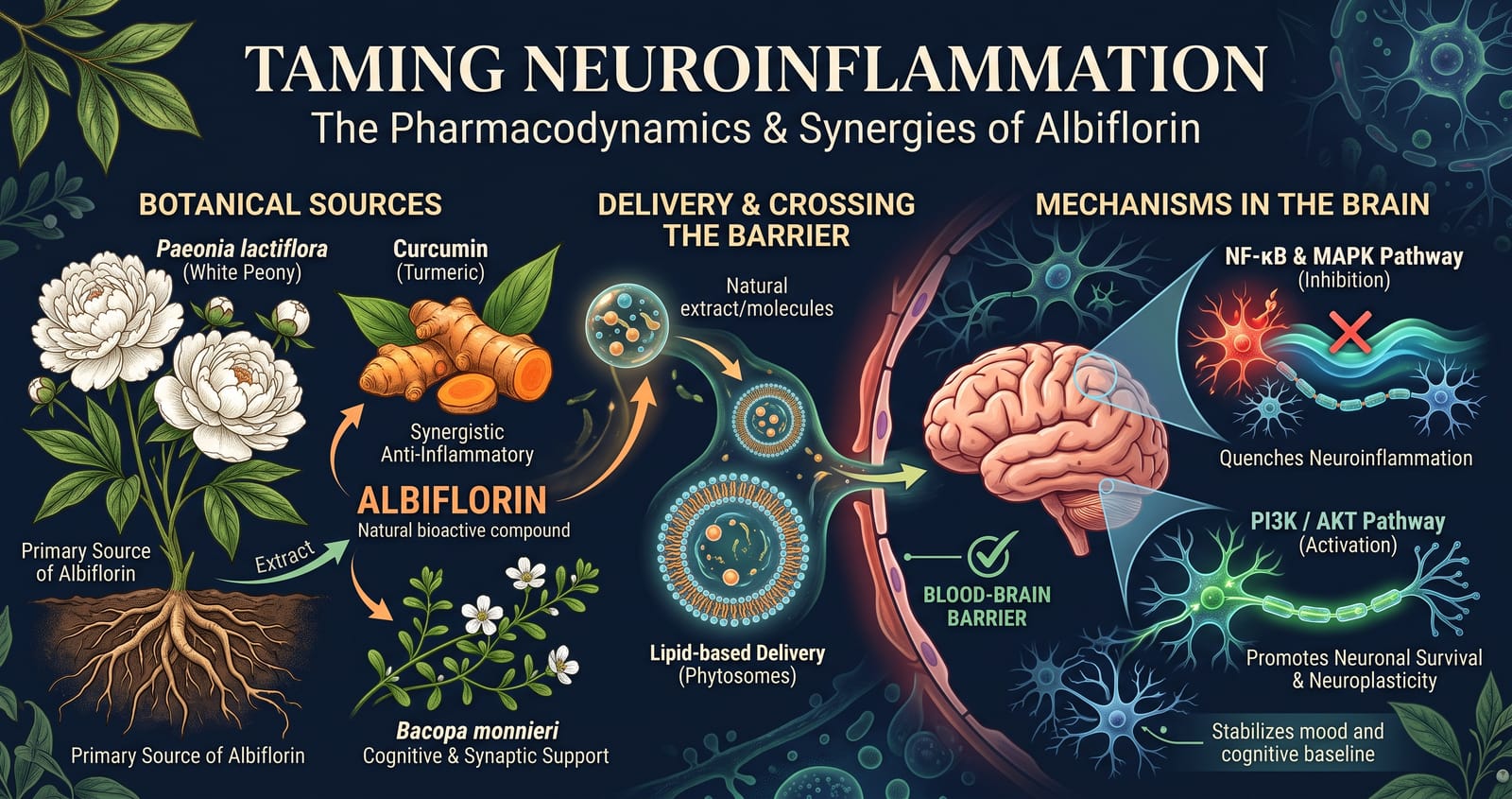
Chronic neuroinflammation and impaired cellular metabolism are key drivers of midday cognitive fatigue and long-term neurodegeneration. Derived from the roots of Paeonia lactiflora (white peony), albiflorin is a bioactive monoterpenoid glycoside gaining traction for its broad-spectrum neuroprotective and psychotropic properties. By operating across multiple regulatory cascades simultaneously, it provides a molecular buffer against inflammatory insult while supporting cell survival pathways in the brain.
The Molecular Mechanisms & Cellular Endpoints
-
Quenching the Inflammatory Cascade (NF-$\kappa$B/MAPK): Albiflorin downregulates key pro-inflammatory pathways, specifically attenuating NF-$\kappa$B nuclear translocation and MAPK signaling. This blunts the transcription of inflammatory cytokines in glial cells, shielding surrounding neurons from chronic inflammatory stress and microglial overactivation.
-
Promoting Neuronal Survival (PI3K/AKT): The compound activates the PI3K/AKT cell-survival axis. This signaling pathway supports neuroplasticity, preserves mitochondrial integrity under oxidative challenge, and promotes synaptic maintenance.
-
Metabolic and Mood Modulation: In addition to structural neuroprotection, albiflorin exhibits modulatory effects on metabolic pathways and central neurotransmission, helping stabilize baseline cognitive performance during systemic metabolic stress.
Practical Considerations & Nootropic Synergies
Maximizing albiflorin’s cognitive benefits requires overcoming clear pharmacokinetic limitations.
-
The Bioavailability Hurdle: Although albiflorin distributes widely upon reaching circulation, its oral bioavailability is inherently poor due to low intestinal permeability and rapid first-pass metabolism. To ensure adequate crossing of the blood-brain barrier, standardized extracts should be coupled with lipid-based delivery formats (such as phytosomes or liposomal encapsulation).
-
Synergistic NF-$\kappa$B Suppression: Stacking albiflorin with curcumin phytosomes provides dual-angle inhibition of the NF-$\kappa$B axis, compounding the suppression of neuroinflammatory markers like IL-6 and TNF-$\alpha$.
-
Cognitive Capacity Stack: Pairing albiflorin with Bacopa monnieri bridges infrastructure protection with functional output. While albiflorin supports cell survival and suppresses inflammation via PI3K/AKT and NF-$\kappa$B, Bacopa enhances cholinergic signaling and synaptic retention for focused mental work.
-
Clinical Boundaries: Because of its anti-inflammatory and metabolic modulatory activities, individuals using prescription anti-inflammatory agents or those managing chronic metabolic disorders should monitor for potential pharmacodynamic interactions.
Reference Wang Q, Xu W, Ye J, Jiang T, Xiong S, Zhang X. A Review of the Pharmacodynamics and Pharmacokinetics of Albiflorin. Comb Chem High Throughput Screen. Published online June 9, 2026. doi: 10.2174/0113862073455210260516223538. https://pubmed.ncbi.nlm.nih.gov/42283174