September 21, 2026
Resetting the Reward Circuit: How Cordycepin Shields Dopamine and Calms Neuroinflammation
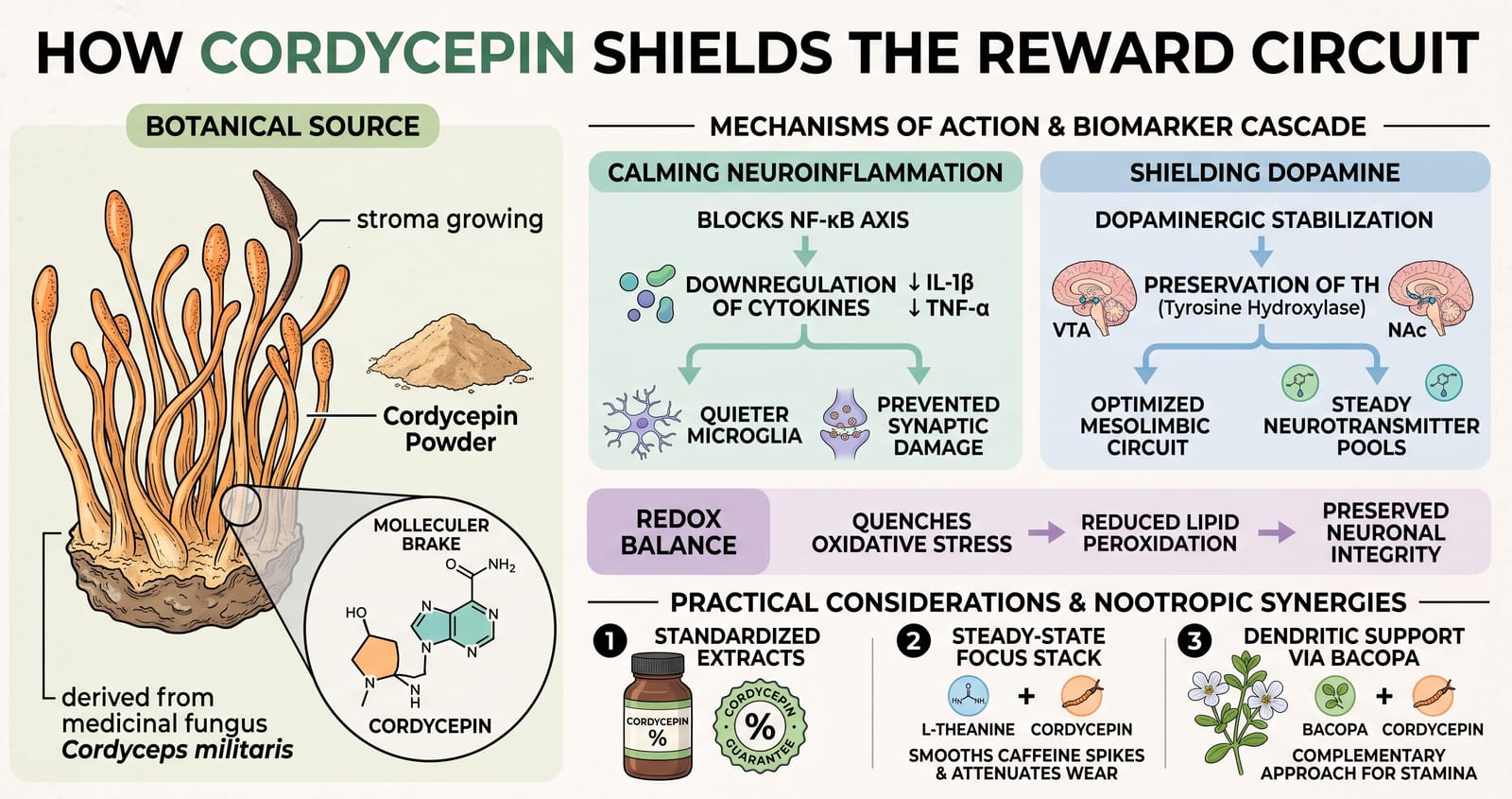
Modern high-performance routines often lean heavily on stimulants to maintain drive, but chronic neurochemical stimulation can trigger receptor desensitization and localized inflammatory stress within the brain's reward centers. Derived from the medicinal fungus Cordyceps militaris, the adenosine analogue cordycepin serves as a molecular brake against stimulant-induced dysregulation. By directly targeting neuroinflammatory transcription and preserving dopaminergic pathways, it helps protect neural circuits from burnout and behavioral sensitization.
The Molecular Mechanisms & Biomarker Cascade
-
Inhibition of the NF-$\kappa$B Axis: Cordycepin blocks nuclear translocation of NF-$\kappa$B, the central regulatory switch for inflammatory signaling. By silencing this cascade, it prevents hyper-reactivity across microglial networks.
-
Downregulation of Inflammatory Cytokines: Suppressing NF-$\kappa$B leads to a marked reduction in key pro-inflammatory cytokines, specifically interleukin-1 beta (IL-1$\beta$) and tumor necrosis factor-alpha (TNF-$\alpha$). This blunts neuroinflammation before it causes structural damage to surrounding synaptic junctions.
-
Dopaminergic Stabilization (TH Preservation): In regions central to motivation and reward processing—the Ventral Tegmental Area (VTA) and the Nucleus Accumbens (NAc)—cordycepin prevents the dysregulation of Tyrosine Hydroxylase (TH), the rate-limiting enzyme in dopamine synthesis. This preserves steady neurotransmitter pools and buffers the mesolimbic circuit against extreme sensitivity spikes.
-
Redox Balance: In addition to moderating inflammatory cascades, cordycepin quenches downstream oxidative stress markers, preventing lipid peroxidation and preserving cellular integrity in high-demand neurons.
Practical Considerations & Nootropic Synergies Translating rodent pharmacology into sustainable human protocols requires attention to extraction quality and neurochemical balance.
-
Standardized Extract Selection: Preclinical doses (1–5 mg/kg in animal models) reflect active cordycepin rather than raw fungal mass. Unstandardized Cordyceps powders frequently dilute active adenosine derivatives, making concentrated extracts with verified cordycepin percentages essential for therapeutic consistency.
-
The "Steady-State" Focus Stack: For individuals relying on regular stimulant intake (such as high-dose caffeine), combining cordycepin with L-Theanine smooths the acute catecholamine spike, while cordycepin attenuates downstream neuroinflammatory wear and tear.
-
Dendritic Support via Bacopa: Stacking cordycepin with standardized Bacopa monnieri provides a complementary dual approach: cordycepin preserves dopamine architecture and mitigates cytokine load, while Bacopa enhances cholinergic activity and synaptic growth for sustained mental stamina.
-
Safety Boundaries: Because cordycepin actively modulates dopamine stability and neuroinflammatory cascades, individuals taking dopaminergic medications or prescription psychiatric compounds should proceed with caution to avoid unexpected interactions.
Reference Ye M, Park JH, Kim CH, Shim I. Cordycepin attenuates nicotine-induced behavioral sensitization through inhibition of NF-κB signaling in rats. Biomed Pharmacother. 2026;201:119476. https://pubmed.ncbi.nlm.nih.gov/42284884/