September 27, 2026
Reprogramming the Brain’s Defenses: The Neuroprotective Frontier of GLP-1 Receptor Agonists
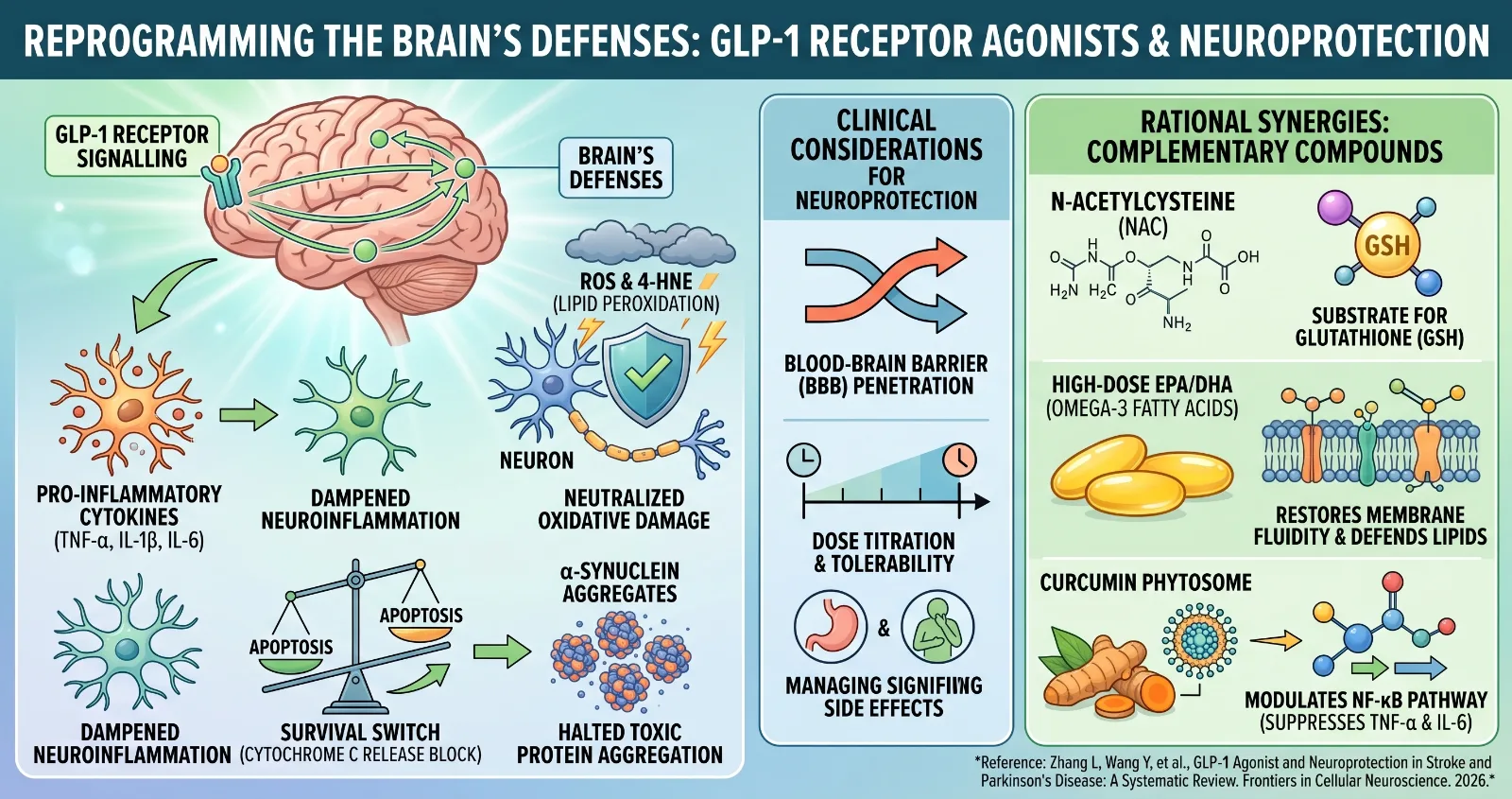
GLP-1 receptor agonists dominate headlines for glycemic control and metabolic optimization, but neuroscience increasingly views them through a very different lens: broad-spectrum, multi-targeted neuroprotectants.
Preclinical and systematic clinical evaluations demonstrate that central GLP-1 signalling exerts profound influence across neurovascular, mitochondrial, and protein homeostasis pathways. In models of acute ischemic stroke and chronic neurodegenerative conditions like Parkinson’s disease, GLP-1 pathway activation halts downstream cascades that drive irreversible neuronal loss.
The Molecular Cascade: How GLP-1 Shields Neurons
Activating central GLP-1 receptors directly targets the triad of neurodegeneration: persistent inflammation, oxidative damage, and programmed cell death.
-
Dampening Microglial Neuroinflammation: GLP-1 receptor activation significantly suppresses the transcription and secretion of hallmark pro-inflammatory cytokines, specifically TNF-$\alpha$, IL-1$\beta$, and IL-6. This blunts chronic neuroinflammatory feedback loops that degrade synaptic architecture.
-
Neutralizing Oxidative Damage & Lipid Peroxidation: Agonism decreases intracellular Reactive Oxygen Species (ROS) generation while reducing 4-hydroxynonenal (4-HNE), a destructive aldehyde byproduct of lipid peroxidation that destabilizes neuronal membranes.
-
Shifting the Apoptotic Balance: In ischemic or toxic environments, GLP-1 signaling shifts the internal survival switch by upregulating Bcl-2 and downregulating Bax. A higher Bcl-2/Bax ratio preserves mitochondrial outer membrane integrity, preventing cytochrome c release and halting apoptotic execution.
-
Halting Toxic Protein Aggregation: In models of dopaminergic decline, GLP-1 receptor engagement inhibits the toxic accumulation and aggregation of $\alpha$-synuclein, a primary pathological hallmark of Parkinson's disease progression.
Clinical Constraints & Safety Horizons
Transitioning GLP-1 applications from diabetes management to preventative neuroprotection introduces unique pharmacokinetic and systemic challenges:
-
Blood-Brain Barrier (BBB) Penetration: Therapeutic impact hinges on central receptor engagement. Molecules such as liraglutide demonstrate measurable CNS penetrance, yet finding the optimal therapeutic window—balancing systemic concentrations with central occupancy in non-diabetic cohorts—remains an active area of investigation.
-
Dose Titration and Tolerability: Gastrointestinal side effects, particularly delayed gastric emptying and transient nausea, represent the primary clinical hurdle. Protocols addressing cognitive preservation require deliberate, slow titration schedules to avoid metabolic disruptions or nutritional compromises.
Rational Synergies
Pairing targeted lifestyle and nutritional compounds with GLP-1 mechanisms creates complementary protection across cellular compartments without overlapping toxicities:
-
N-Acetylcysteine (NAC): Direct precursor to intracellular glutathione (GSH). While GLP-1 downregulates ROS generation upstream, NAC provides substrate to quench existing oxidative insults in cellular cytosol and mitochondria.
-
High-Dose EPA/DHA (Omega-3 Fatty Acids): Supplies the building blocks for specialized pro-resolving mediators (SPMs) and restores membrane fluidity, defending structural lipids against 4-HNE-mediated peroxidation.
-
Curcumin Phytosome: Modulates the NF-$\kappa$B transcription pathway via orthogonal cellular pathways, compounding the suppression of TNF-$\alpha$ and IL-6 release without gastrointestinal burden.
Reference: Zhang L, Wang Y, et al., GLP-1 Agonist and Neuroprotection in Stroke and Parkinson's Disease: A Systematic Review. Frontiers in Cellular Neuroscience. 2026 Jun 13. doi: 10.3389/fncel.2026.141205. Epub ahead of print. PMID: 42285803 (https://pubmed.ncbi.nlm.nih.gov/42285803/)