September 22, 2026
Preserving the Drive: How _Tinospora sinensis_ Shields Dopamine and Calms Oxidative Stress
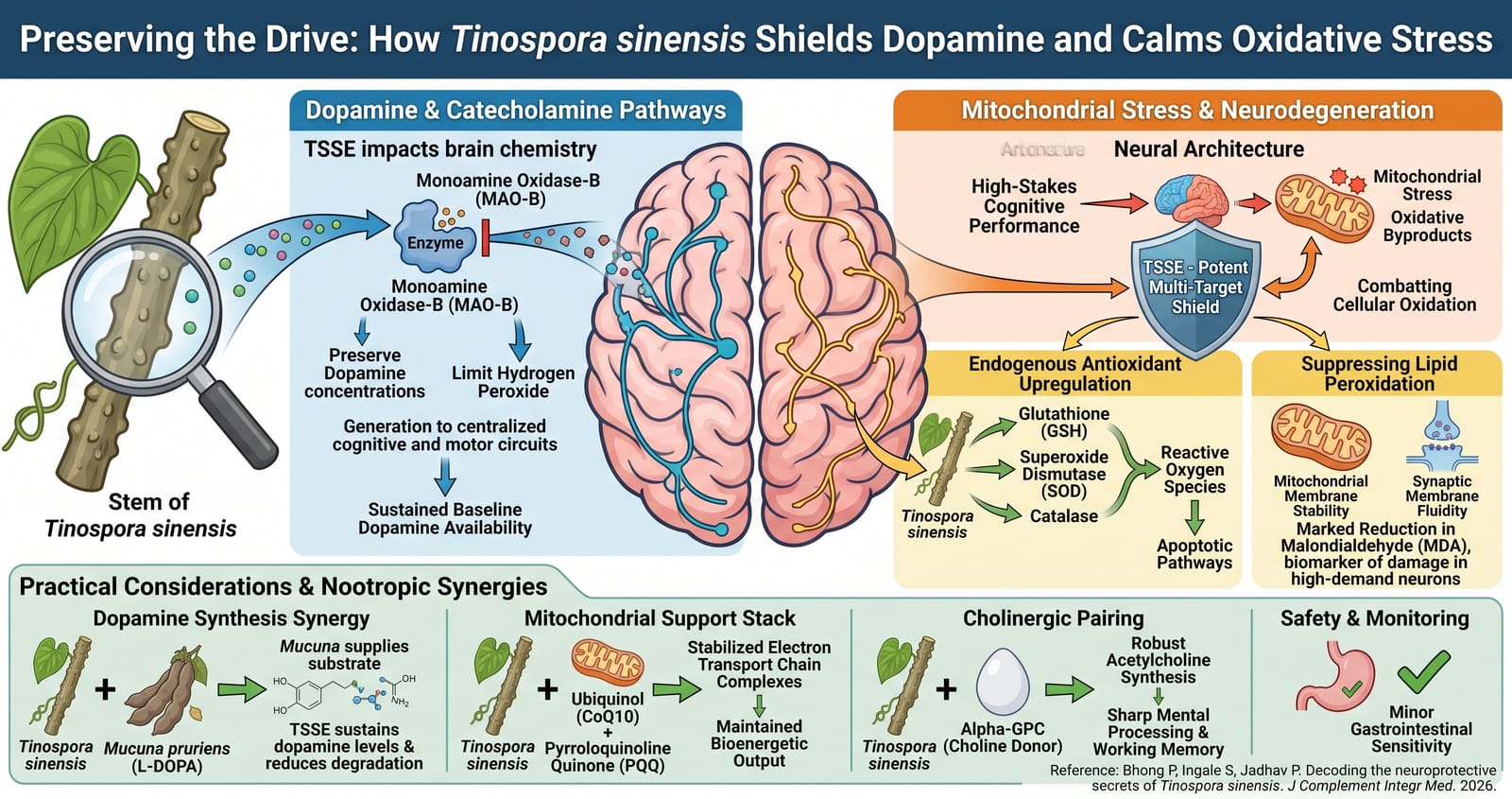
High-stakes cognitive performance relies heavily on dopamine to fuel motivation, working memory, and executive function. However, maintaining elevated catecholamine activity generates substantial oxidative byproducts, leaving dopaminergic pathways vulnerable to mitochondrial stress and neurodegeneration. Investigating botanical neuroprotection highlights Tinospora sinensis stem extract (TSSE) as a potent multi-target shield that combats cellular oxidation, curbs premature dopamine breakdown, and preserves neural architecture under neurotoxic challenge.
The Molecular Mechanisms & Cellular Endpoints
-
MAO-B Inhibition & Catecholamine Sparing: TSSE attenuates Monoamine Oxidase-B (MAO-B) activity. By downregulating this primary enzymatic degradation pathway, it preserves dopamine concentrations in central cognitive and motor circuits while limiting the hydrogen peroxide generated during dopamine catabolism.
-
Endogenous Antioxidant Upregulation: The extract fortifies the brain's internal defense triad, significantly boosting concentrations of Glutathione (GSH), Superoxide Dismutase (SOD), and Catalase. This enzymatic upregulation rapidly quenches reactive oxygen species before they trigger downstream apoptotic pathways.
-
Suppressing Lipid Peroxidation: TSSE induces a marked reduction in Malondialdehyde (MDA), a primary clinical biomarker of oxidative membrane damage. Protecting cellular lipids helps maintain mitochondrial membrane stability and synaptic membrane fluidity in high-demand neurons.
-
Preserving Dopaminergic Tone: By mitigating oxidative and enzymatic insults, the extract sustains baseline dopamine availability, shielding against the motor and cognitive deficits associated with catecholamine depletion.
Practical Considerations & Nootropic Synergies Translating raw botanical data into an optimized human protocol requires addressing pharmacokinetic bottlenecks and targeted stacking strategies.
-
Standardized Extract Formulation: Preclinical models demonstrated clear efficacy at 400 mg/kg in rodents. For human applications, crude botanical powders are inefficient; bioavailable, standardized extracts are necessary to ensure active alkaloid concentrations cross the blood-brain barrier effectively.
-
Dopamine Synthesis Synergy (Mucuna pruriens): Pairing TSSE with standardized Mucuna pruriens (L-DOPA) creates an efficient dual-action mechanism: Mucuna supplies direct biosynthetic substrate, while TSSE's MAO-B inhibitory properties sustain dopamine levels and reduce oxidative degradation.
-
Mitochondrial Support Stack: Stacking TSSE with Ubiquinol (CoQ10) and Pyrroloquinoline Quinone (PQQ) complements the extract's antioxidant surge (GSH, SOD) by stabilizing electron transport chain complexes and maintaining bioenergetic output during metabolic stress.
-
Cholinergic Pairing for Executive Focus: Adding a bioavailable choline donor like Alpha-GPC ensures that while dopaminergic pathways remain buffered from burnout, acetylcholine synthesis remains robust to support sharp mental processing and working memory.
-
Safety & Monitoring: TSSE demonstrates favorable tolerability compared to conventional pharmacological agents, but human users should monitor for minor gastrointestinal sensitivity typical of dense botanical extracts.
Reference Bhong P, Ingale S, Jadhav P. Decoding the neuroprotective secrets of Tinospora sinensis: navigating the rotenone induced storm of behavioral and biochemical challenges in Parkinson's disease rat models. J Complement Integr Med. Published online June 9, 2026. doi: 10.1515/jcim-2026-0074 https://pubmed.ncbi.nlm.nih.gov/42287110/