September 16, 2026
Multi-Target Neuroprotection: Decoding Zuo Gui Wan Against Alzheimer's Pathology
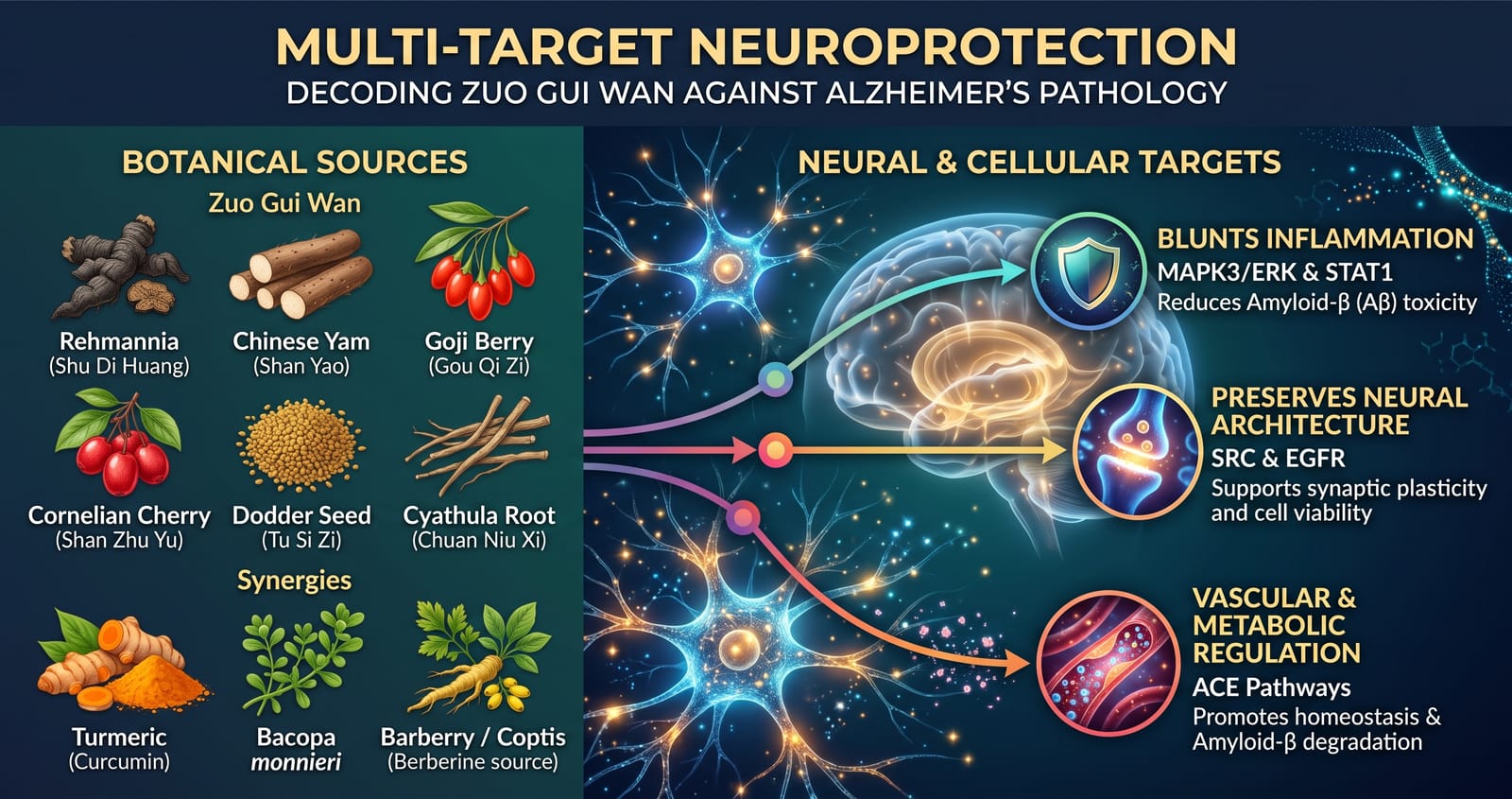
Complex neurodegenerative conditions like Alzheimer's disease rarely stem from a single broken mechanism; they involve a web of neuroinflammation, amyloid-beta ($A\beta$) toxicity, and synaptic decay. Rather than relying on a single "silver bullet," botanical medicine often leverages polypharmacology—simultaneously modulating several physiological cascades. Network pharmacology and cellular analysis of the classical formula Zuo Gui Wan (ZGW) highlight how multi-compound botanical architectures shield aging neurons from toxic insults and inflammatory cascades.
The Molecular Mechanisms & Signaling Cascades
-
Blunting Neuroinflammation via MAPK3/ERK and STAT1: ZGW suppresses chronic neuroinflammatory signaling by modulating the MAPK3/ERK cascade and downregulating STAT1 activation. This shift dampens inflammatory signaling that accelerates neuronal damage and cognitive impairment.
-
Preserving Neural Architecture via SRC and EGFR: The formulation modulates SRC kinase and EGFR (epidermal growth factor receptor) signaling. These networks are essential for stabilizing cytoskeletal architecture, promoting synaptic plasticity, and maintaining cellular viability under stress.
-
Vascular and Metabolic Regulation via ACE: ZGW targets angiotensin-converting enzyme (ACE) pathways. Regulating ACE activity plays an important role in neurovascular homeostasis, local cerebral perfusion, and the enzymatic degradation dynamics of amyloid-beta deposits.
-
Key Bioactive Compounds: Active constituents within the formula—including the alkaloid berberine—act synergistically to hit these pathways at lower individual thresholds than isolated monotherapies would require.
Practical Considerations & Nootropic Synergies Translating traditional multi-herb preparations into evidence-informed protocols requires addressing absorption constraints and compound interactions.
-
Bioavailability Enhancements: Key actives such as berberine exhibit relatively low passive intestinal permeability and limited blood-brain barrier (BBB) crossing when taken in isolation. Utilizing the complete multi-herb matrix—or pairing with lipid-based phytosome delivery systems—enhances systemic uptake and tissue distribution.
-
Synergistic STAT1 Inhibition: Combining ZGW extracts with bioavailable curcumin phytosomes provides complementary inhibition of STAT1 and downstream NF-$\kappa$B transcription, producing a broader reduction in baseline neuroinflammatory stress.
-
Synaptic Plasticity Stacking: Pairing this protective formula with an adaptogenic cognitive enhancer like Bacopa monnieri supports acetylcholine signaling and dendritic branching, complementing ZGW's structural and metabolic protection.
-
Enzyme and Interaction Monitoring: Berberine modulates cytochrome P450 enzymes (notably CYP3A4 and CYP2D6). Individuals taking prescription therapeutics metabolized through these pathways should exercise caution to avoid altered drug plasma levels.
Reference Ma Z, Yang Z, Xiao Z, Huang B, Wang X. Unveiling the multi-target mechanisms of Zuo Gui Wan in Alzheimer's disease: An integrated study combining network pharmacology, Mendelian Randomization, and molecular docking. Brain Res Bull. 2026;243:111972. doi: 10.1016/j.brainresbull.2026.111972. https://pubmed.ncbi.nlm.nih.gov/42259474/