September 23, 2026
Cooling the Brain's Fire: How Echinocystic Acid Protects Memory and Lifts Mental Fatigue
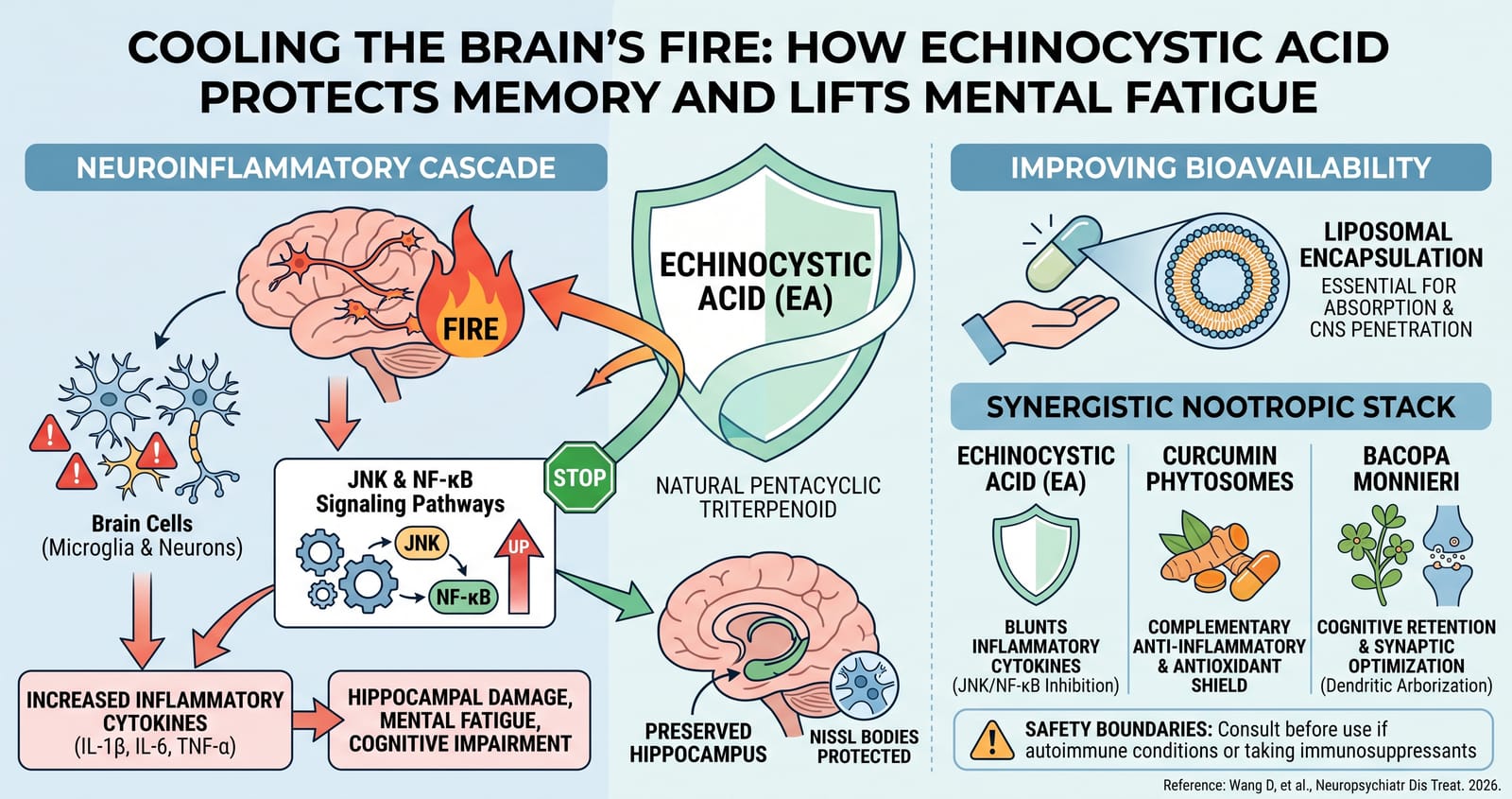
Severe neurovascular events and chronic physiological stress trigger intense neuroinflammatory cascades that damage emotional regulation networks and impair cognitive performance. When inflammatory alarms sound unchecked in the central nervous system, hippocampal integrity degrades, contributing directly to post-injury depressive symptoms and persistent mental fatigue. Emerging research highlights echinocystic acid (EA)—a natural pentacyclic triterpenoid—as an effective molecular brake capable of suppressing these inflammatory cascades and preserving hippocampal neurons under acute neurotoxic stress.
The Molecular Mechanisms & Cellular Endpoints
-
Dual-Inhibition of the JNK and NF-$\kappa$B Cascades: Echinocystic acid works primarily by dampening the c-Jun N-terminal kinase (JNK) and nuclear factor kappa B (NF-$\kappa$B) signaling axes. Because these pathways act as master transcription regulators for inflammatory signaling, suppressing them halts chronic, low-grade neuroinflammation at the source.
-
Downregulation of Inflammatory Cytokines: Suppressing these upstream pathways drives a marked reduction in key pro-inflammatory cytokines: interleukin-1 beta (IL-1$\beta$), interleukin-6 (IL-6), and tumor necrosis factor-alpha (TNF-$\alpha$). This blunts microglial overactivation before it inflicts collateral damage on surrounding synaptic structures.
-
Hippocampal Preservation & Structural Integrity: In vulnerable neural zones like the dentate gyrus, echinocystic acid preserves Nissl bodies and prevents cell death. Protecting these structural elements directly preserves the synaptic architecture required for stable mood regulation, working memory, and emotional resilience.
Practical Considerations & Nootropic Synergies Translating preclinical triterpenoid findings into real-world human protocols requires overcoming classic pharmacokinetic barriers.
-
The Bioavailability Hurdle: While preclinical models established efficacy using daily systemic administration across a 28-day timeframe, pentacyclic triterpenoids naturally face intestinal solubility hurdles and restricted blood-brain barrier transport. Formulating echinocystic acid using lipid-based carriers or liposomal encapsulation is essential to ensure therapeutic systemic absorption and central nervous system penetration.
-
Synergistic Cytokine Blunting (Curcumin Phytosomes): Stacking echinocystic acid with bioavailable curcumin phytosomes provides complementary inhibition across parallel inflammatory pathways. While EA directly shuts down JNK and NF-$\kappa$B translocation, curcumin quenches downstream reactive oxygen species, creating a multifaceted anti-inflammatory shield.
-
Cognitive Retention via Bacopa: Pairing EA with Bacopa monnieri bridges structural protection with synaptic optimization. While echinocystic acid shields dentate gyrus neurons from inflammatory necrosis, Bacopa supports dendritic arborization and cholinergic tone to maintain mental clarity and processing speed.
-
Safety Boundaries: Although no acute toxicities were observed in models, modulating key immune regulators like NF-$\kappa$B calls for clinical prudence in individuals with autoimmune conditions or those using prescription immunosuppressant medications.
Reference Wang D, Li W, Zhang X, et al. Echinocystic Acid Antagonizes Post-Stroke Depression in Mice by Suppressing the JNK/NF-κB Signaling Pathway. Neuropsychiatr Dis Treat. 2026;22:596008. Published 2026 Jun 5. doi: 10.2147/NDT.S596008 https://pubmed.ncbi.nlm.nih.gov/42272872/