September 29, 2026
Beyond the Pancreas: GLP-1 Receptor Agonists as Multi-System Neuroprotective Stabilizers
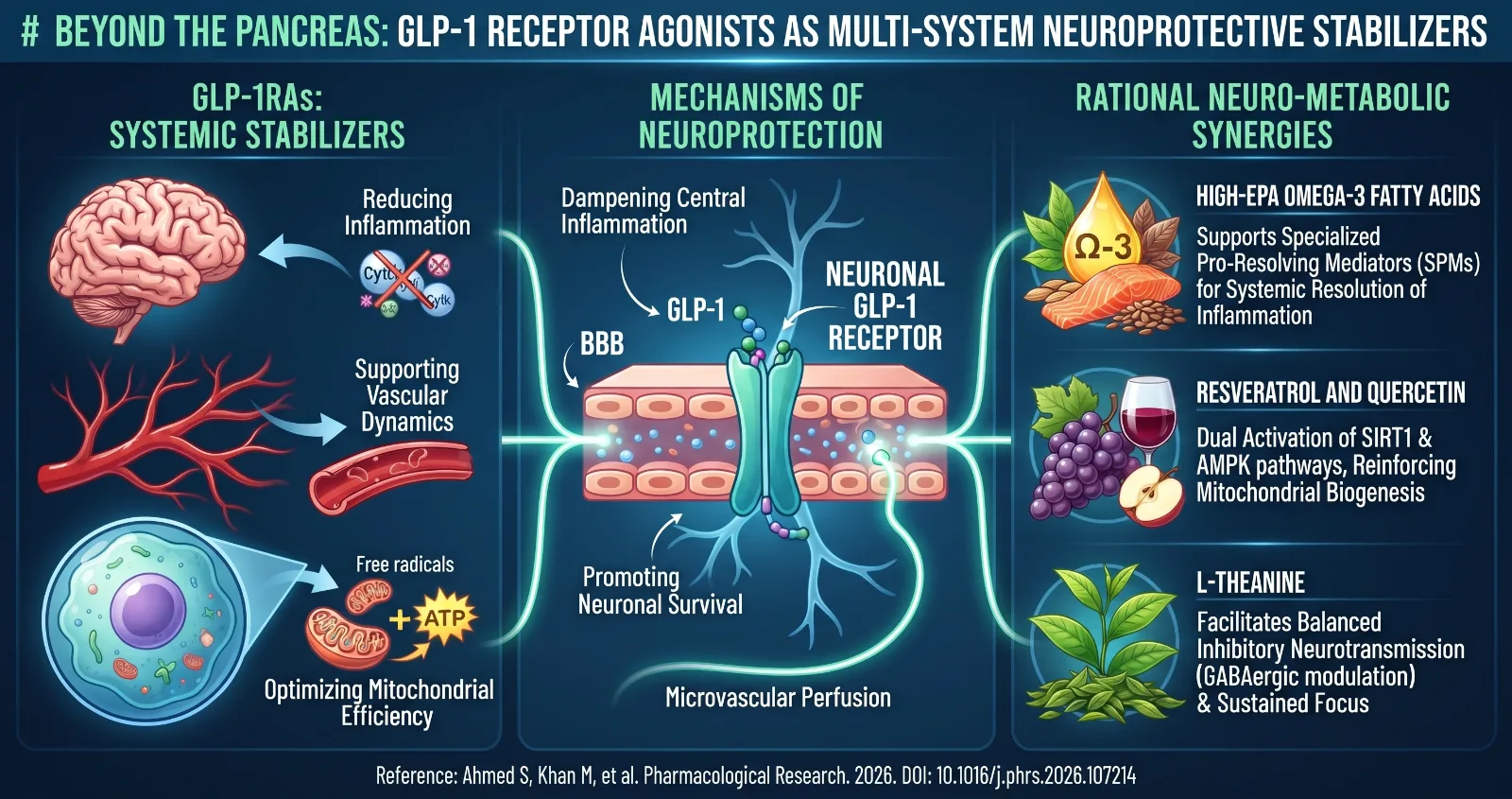
Glucagon-like peptide-1 receptor agonists (GLP-1RAs) have fundamentally reshaped metabolic medicine, but their physiological reach extends far beyond insulin secretion and glycemic control. Accumulating evidence indicates that GLP-1RAs function as multi-system homeostatic stabilizers capable of mitigating systemic inflammatory tone, supporting vascular dynamics, and shielding neural tissue from metabolic decay.
For cognitive preservation, metabolic dysfunction and persistent low-grade inflammation are twin drivers of accelerated brain aging and mental fatigue. Activating GLP-1 pathways presents a systemic strategy to clean up that internal biochemical environment.
The Molecular Architecture: From Glycemic Control to Neurovascular Resilience
The neuroprotective utility of GLP-1 receptor activation operates via coordinated systemic and direct central mechanisms:
-
Dampening Pro-Inflammatory Signaling: GLP-1RAs attenuate peripheral and central pro-inflammatory cascades, reducing circulating inflammatory cytokines that otherwise compromise blood-brain barrier (BBB) integrity and induce microglial priming.
-
Mitochondrial Efficiency & Metabolic Homeostasis: By optimizing cellular glucose uptake and modulating downstream metabolic pathways, GLP-1 signaling promotes mitochondrial bioenergetic stability, reducing excess intracellular reactive species generation.
-
Neuroprotection and Cellular Defense: Preclinical models demonstrate that central GLP-1 receptor engagement fosters neuronal survival pathways and supports microvascular perfusion, decoupling age-associated metabolic stress from structural neurodegeneration.
Pharmacokinetics, Delivery, and Clinical Constraints
Translating GLP-1 receptor agonism into longevity and neuroprotection protocols requires addressing specific physiological barriers:
-
Blood-Brain Barrier Permeability: While systemic bioavailability is high across standard injectable and oral formulations, central receptor access varies significantly by molecular structure and peptide half-life. Current human data on direct CNS targets remain heterogeneous, with much of the neuroprotective benefit derived from combined systemic anti-inflammatory actions alongside direct receptor occupancy.
-
Gastrointestinal Kinetics & Tolerability: Delayed gastric emptying, transient nausea, and digestive sensitivity represent the most common operational constraints. Controlled, gradual dose titration is required to prevent gut dysmotility while establishing steady-state systemic protection.
-
Clinical Oversight: Because GLP-1RAs are potent metabolic modulators with rare clinical risks involving the pancreas or gallbladder, their use outside traditional glycemic management demands rigorous physician monitoring of metabolic markers and digestive tolerance.
Rational Neuro-Metabolic Synergies
Pairing GLP-1RAs with targeted non-pharmaceutical interventions can amplify anti-inflammatory pathways and protect cellular structures from complementary vectors:
-
High-EPA Omega-3 Fatty Acids: Provides substrate for specialized pro-resolving mediators (SPMs) to resolve vascular and systemic inflammatory cascades, compounding the anti-inflammatory signaling of GLP-1 activation.
-
Resveratrol and Quercetin: Dual polyphenolic activation of SIRT1 and AMPK pathways offers orthogonal cellular protection against oxidative stress while reinforcing mitochondrial biogenesis.
-
L-Theanine: Facilitates balanced inhibitory neurotransmission (GABAergic modulation) and sustained focus to buffer transient autonomic or subjective shifts during metabolic adaptation phases.
Reference: Ahmed S, Khan M, et al., GLP-1 Receptor Agonists as Multisystem Therapies: From Glycemic Control to Cardio- and Neuroprotection. Pharmacological Research. 2026 Jun 11. doi: 10.1016/j.phrs.2026.107214. Epub ahead of print. PMID: 42271434 (https://pubmed.ncbi.nlm.nih.gov/42271434/)