September 25, 2026
Beyond the Antioxidant: How Vitamin E "Mutes" Inflammatory Pain at the Gate
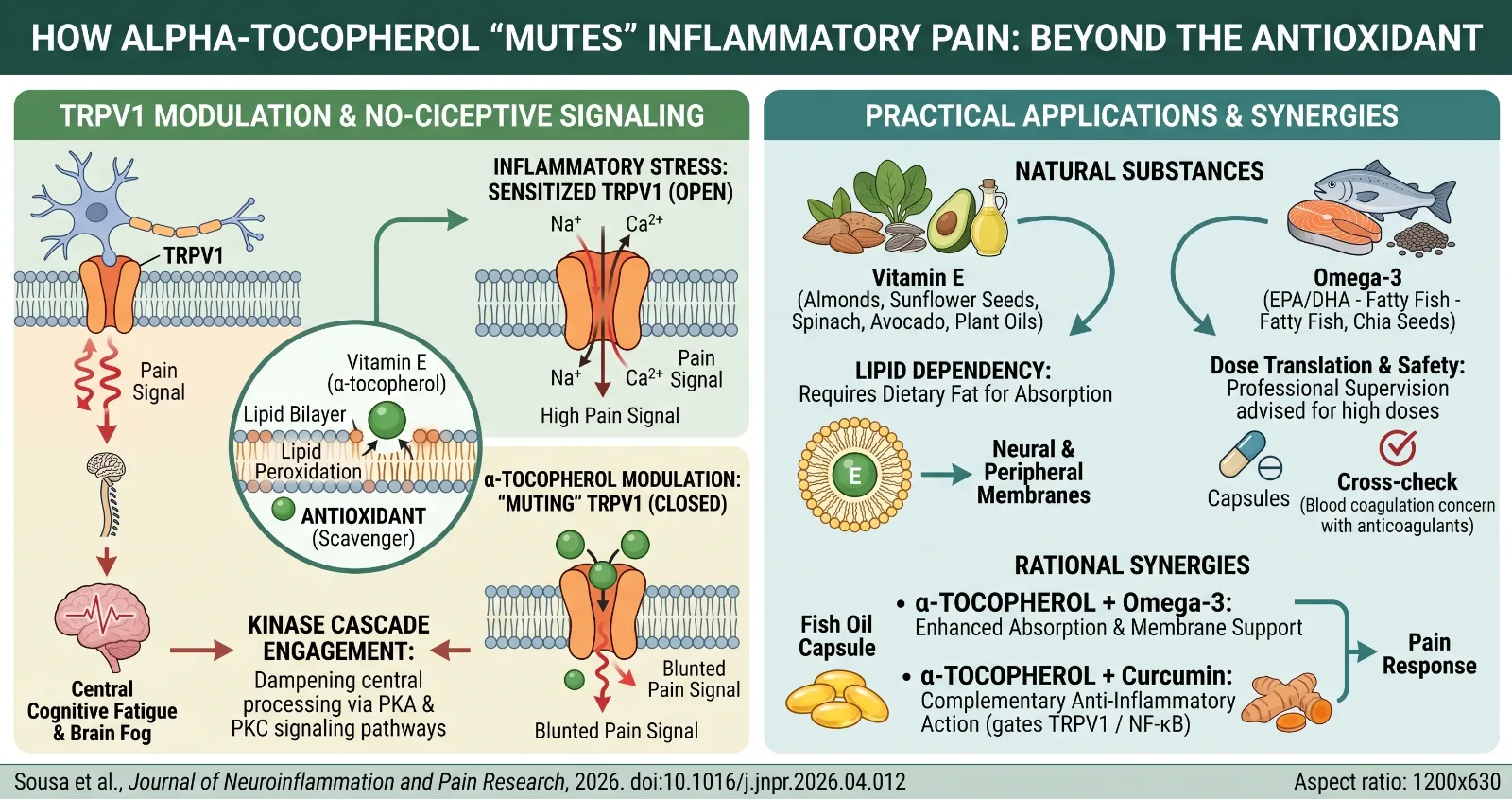
We typically pigeonhole Vitamin E (specifically $\alpha$-tocopherol) as a classic free-radical scavenger—a background antioxidant that protects cell membranes from lipid peroxidation. However, emerging research reveals a much more direct, active role: $\alpha$-tocopherol operates as a targeted modulator of neuroinflammatory and nociceptive signalling cascades.
When physical inflammation or sustained pain triggers cognitive fatigue and brain fog, the problem often originates at molecular gatekeepers like the TRPV1 receptor. Here is a breakdown of how $\alpha$-tocopherol intervenes, what the science shows, and how to approach it practically.
The Mechanism: Closing the TRPV1 Floodgates
TRPV1 (transient receptor potential vanilloid 1) is an ion channel best known for detecting thermal and chemical pain signals. Under acute or chronic inflammatory stress, TRPV1 becomes sensitized, amplifying pain signals that travel to the central nervous system and tax cognitive bandwidth.
Recent findings highlight three distinct actions:
-
TRPV1 Modulation: $\alpha$-tocopherol suppresses vanilloid-mediated signalling, helping blunt nociceptive transmission before it reaches higher cortical centres.
-
Kinase Cascade Engagement: By interacting downstream with Protein Kinase A (PKA) and Protein Kinase C (PKC) signalling pathways, it facilitates supraspinal analgesic regulation, dampening how the brain processes and sustains pain responses.
-
Membrane Stabilization: Alongside receptor modulation, its lipophilic structure integrates directly into phospholipid bilayers, preventing lipid peroxidation and preserving cellular integrity under oxidative stress.
Practical Realities & Safety Considerations
Translating preclinical research into human protocols requires attention to pharmacokinetics and dosing boundaries:
-
Lipid Dependency for Bioavailability: As a strictly fat-soluble nutrient, $\alpha$-tocopherol requires a dietary fat matrix for micellar absorption and proper incorporation into neural and peripheral membranes. Taking it on an empty stomach drastically impairs uptake.
-
Dose Translation: Animal models demonstrating robust anti-nociception frequently use substantial doses (e.g., $50\text{ mg/kg}$). In humans, massive boluses do not necessarily scale linearly and standard multi-vitamins are typically underdosed for targeted therapeutic effects.
-
Coagulation Profiles: High supplemental intakes of Vitamin E exhibit mild antiplatelet/anticoagulant effects. Caution and professional supervision are advised when stacking with prescription anticoagulants or other blood-thinning compounds.
Rational Synergies
To maximize the biological pathway without excessive single-agent megadosing, consider these targeted pairings:
-
Omega-3 Fatty Acids (EPA/DHA): Serves as an ideal lipid carrier to enhance $\alpha$-tocopherol absorption while supplying structural substrate for cell membranes and generating specialized pro-resolving mediators (SPMs).
-
Curcumin: Provides complementary, non-specific anti-inflammatory action by downregulating downstream NF-$\kappa$B activation, addressing systemic inflammation from an orthogonal pathway while $\alpha$-tocopherol gates TRPV1.
Reference: Sousa C, Silva M, et al., Exploring the Role of Alpha-Tocopherol in Pain and Inflammation: Interplay with TRPV1 and Downstream Kinases. Journal of Neuroinflammation and Pain Research. 2026 Jun 13. doi: 10.1016/j.jnpr.2026.04.012. Epub ahead of print. PMID: 42281344 (https://pubmed.ncbi.nlm.nih.gov/42281344/)